
Sagging Type: Why Not to Start with a Thread Lift
Tissue change remains where a thread has passed, and repetition narrows later options. Dr Song Myeong-seung of NUWA Clinic Gangnam on the order from device lifting to facelift.
Contents
Hello. I am Dr Song Myeong-seung of NUWA Clinic Gangnam, where I diagnose the concern before I treat the face.
In my last piece I went through three face shapes: the peanut, the square and the round. There is in fact one more. It is not a face shape you are born with, but one that develops as time passes.
“My face seems to have spread out.” “It looks bigger than it used to.” The people who say this are describing that fourth type.
What is the sagging type?
The sagging type is one where tissue in the cheeks and around the mouth has descended, blurring the lines of the face so that it appears to have spread.
You have not put on weight, yet the face looks wider and the jawline has become indistinct. It often shows up more in photographs than face to face. The face has not actually grown larger; the lines of it have come down.
This is why the sagging type calls for a different approach from the others. The aim is not to reduce something but to lift what has descended.
Which layer did the sagging come from?
Sagging divides into an early stage, where skin resilience has begun to decline, and a later one, where the descent reaches down to the fascial layer supporting the face.
The two can look like the same sagging while calling for entirely different approaches. For a simple check, lift your cheek slightly with your fingers. If a light lift tidies the jawline, you are closer to the early stage; if you have to apply real force before the line falls into place, the deeper layer is what needs looking at.
Titanium Lifting for early loss of resilience
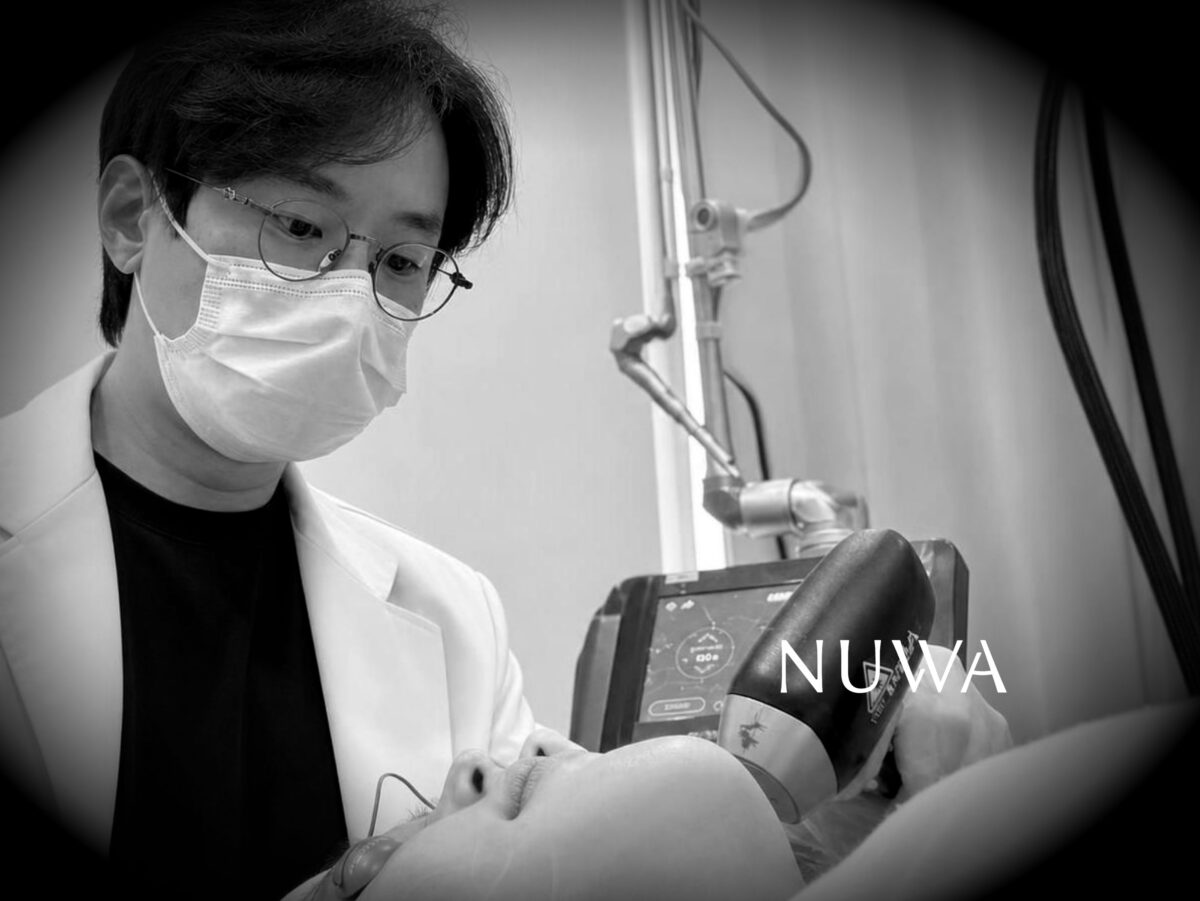
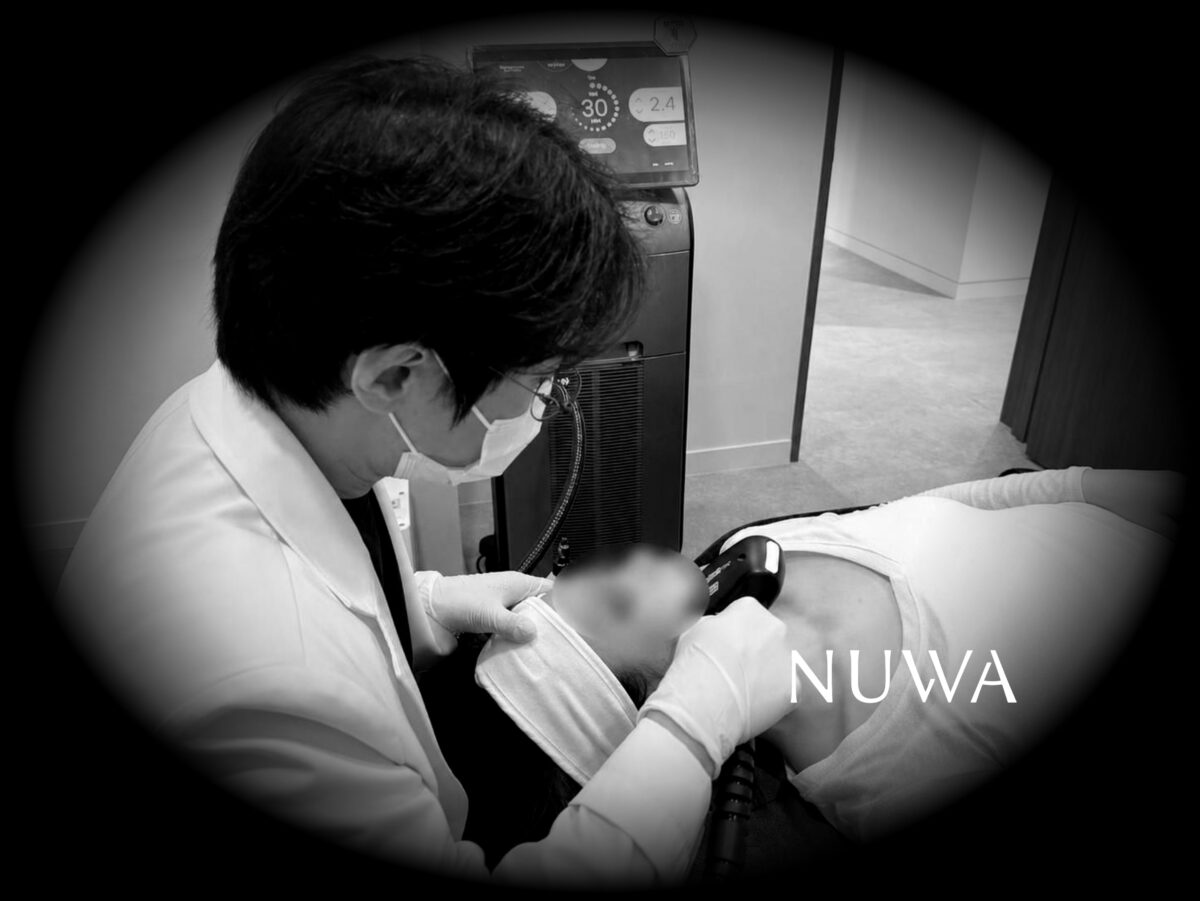
Where skin resilience has declined but the stage is still early, I look at device-based lifting first.
Titanium Lifting uses three laser wavelengths to deliver heat to several layers of the skin, raising resilience and tidying the line. Discomfort is limited and a return to daily life straight afterwards is usually possible, so it is a lighter treatment in character. It suits those who want to look at skin texture and tone alongside the sagging, rather than sagging alone.
Ultherapy where the descent reaches the fascial layer
Where the descent has begun at the fascial layer, I look at Ultherapy.
Ultherapy uses ultrasound to deliver energy down to the fascial layer supporting the face, lifting descended tissue from the inside. There is one thing I always check here, though. Where someone does not have much facial fat to begin with, Ultherapy can reduce cheek fat along with everything else and leave the cheeks looking hollow. So it is not only the degree of sagging that has to be assessed but also how much fat there is in the face.
With Ultherapy, where you deliver it decides the result
Even with the same device and the same shot count, the result changes with which area the energy goes into and at what depth.
The descended area has to be identified precisely and the energy placed where it is needed, and there are times when areas with thin tissue have to be avoided altogether. This is the thing I have felt most clearly over ten years of carrying out these treatments. Ultherapy is a device whose results vary considerably with the person operating it.
Why I don’t recommend starting with a thread lift
People who come in about sagging often raise thread lifts first. The idea of pulling something upwards is intuitive.
I do not, however, recommend starting there. To explain why, I have to start with how a thread lift produces its effect.
What is left behind where a thread has passed?
The effect of a thread lift comes not from the thread but from the tissue the thread changed as it passed through.
A thread lift works in two ways. One is the force of the barbs on the thread physically catching and lifting descended tissue. The other is the stimulation that prompts collagen to form around the thread as it dissolves.
Most threads dissolve and disappear within the body inside six months. The reason the effect lasts longer than that is that the collagen and fibrous tissue produced as the thread dissolves remain in place. That is where the persistence of the effect after the thread has gone comes from.
Which is another way of saying that the area is not in the same state it was in before the procedure.
Each repetition narrows the options that follow
Repeating thread lifts without leaving intervals allows fibrosis and adhesion to accumulate.
Leaving sufficient intervals, on the other hand, means that change accumulates in a way that keeps hold of resilience steadily. The problem is repeating without leaving an interval. When another thread goes into tissue that has already changed, the layers stick to one another, which makes separating them difficult later on in surgery that works with tissue planes, such as a facelift.
That does not mean surgery becomes impossible. It means it becomes harder to predict, and that the same operation can be carried out under less favourable conditions. This is why I look at thread lifts in terms of number and spacing, calculating together how many have been used so far and how many remain available.
The order for approaching sagging, from devices to facelift
I look at sagging in the order of device lifting, thread lift, then facelift.
I start by approaching it with device lifting, trying what is possible at the current stage first. Where that alone is not enough, I consider a thread lift, and even then I set a number and plan around it. Where the sagging still is not resolved, I discuss a facelift alongside it.
A facelift is surgery that pulls descended tissue up directly, so it is the most definitive method, and for that reason I place it last. The reason for going in order from the lighter options is not that they are weak. It is to keep the facelift fully available as an option for the point at which it is needed.
Ultherapy from your twenties — is it necessary?
Starting care early is a good thing, but there is no need for that start to be the strongest treatment available.
Ultherapy and Thermage deliver thermal stimulation down to deep layers. At a stage where sagging has progressed, that intensity is needed; at a stage where resilience is still intact, it may not be.
In that case it is better to start with less demanding treatments. Use only as much as is needed now, and keep the stronger treatments as a card to play when they are genuinely required. It is the same point I made about thread lifts. Spend it all now and there is less left to draw on later.
In the end it is condition, not age
Even at the same age, which layer the sagging came from differs from person to person.
Among people in their twenties, some have ample resilience while others have already begun to sag. By the forties, sagging has usually progressed to some degree, but even within that, which layer has descended differs. Someone whose loss is mainly in skin resilience and someone whose descent reaches the fascial layer call for different approaches at the same age.
So I do not decide by age. I look at which layer the sagging came from now, how much fat there is in the face, and what order to go in from here, and then decide how much is needed at this point.
Three things to check before treatment for the sagging type
If sagging is on your mind and you are looking into lifting, there are three things to establish before you come in.
Whether the sagging is at an early stage or has descended from the fascial layer; how much fat there is in your face; and whether a thread lift is genuinely required at this stage or is something to save for later. The right order emerges once these three are settled.
If you feel your face has spread out, I will look at which layer it came from with you. You can also see how the lifting options compare in our lifting guide.
This has been Song Myeong-seung of NUWA Clinic Gangnam, where face shape concerns are diagnosed first. NUWA Clinic Gangnam is directly in front of Exit 7 of Gangnam Station, on the 3rd and 4th floors at 385 Gangnam-daero, Seocho-gu, Seoul.
Frequently asked questions
Q. My face seems bigger. Have I put on weight?
A. If your face looks wider without weight gain, it may be sagging. As tissue in the cheeks and around the mouth descends, the jawline blurs and the face appears larger.
Q. Can’t I have a thread lift first?
A. It is less a matter of not being able to than one of order. Tissue change remains where a thread has passed, and the range of later choices can narrow with repetition, so I recommend looking at device lifting first.
Q. Should I have Titanium Lifting or Ultherapy?
A. It depends on which layer the sagging came from. Where skin resilience has declined at an early stage I look at Titanium Lifting; where the descent has begun at the fascial layer I look at Ultherapy.
Q. I don’t have much facial fat. Can I still have Ultherapy?
A. Where facial fat is limited, cheek fat can reduce along with everything else and leave the cheeks looking hollow, so I approach this carefully. I check tissue thickness and the degree of sagging together before deciding on a direction.
Q. What is the difference between a thread lift and a facelift?
A. A thread lift inserts threads to pull tissue upwards, while a facelift is surgery that pulls descended tissue up directly. A facelift is more definitive but has a longer recovery period, so I approach them in order according to the stage of sagging.
Q. Do repeated thread lifts make a facelift harder later?
A. Tissue change remains where a thread has passed. Repeating without intervals allows fibrosis and adhesion to accumulate, which can make separating layers difficult in later surgery, so it is better to approach with the number and spacing planned in advance.
Q. From what age should I start lifting?
A. The measure is the stage of sagging rather than age. The layer and degree differ even at the same age, so I advise after diagnosis.
Q. I am in my twenties. Can I have Ultherapy or Thermage?
A. Starting care early is a good thing, but there is no need for that start to be the strongest treatment. At a stage where resilience is still intact, it is better to look at less demanding treatments first and keep the stronger ones for when they are needed.
*Effects and results of this treatment may vary with individual condition, and responses such as redness, swelling, warmth or discomfort may appear afterwards. Accurate diagnosis and the decision on whether to proceed should always be made through consultation with a specialist.

NUWA Clinic Gangnam
Dermatology · Lead Director, NUWA Clinic Gangnam
With know-how built over 10 years and more than 120,000 procedures, I'll help you find the answer to your facial concerns.