
Xerf and Ultherapy: What Is the Difference?
Ultherapy focuses ultrasound on the fascial layer; Xerf spreads radiofrequency across the dermis. NUWA Clinic Gangnam on which layer your sagging began in.
Contents
From the late twenties, changes begin to set in little by little: the jawline collapses, the deep cheeks become blunted and the nasolabial folds deepen. This is because the synthesis of collagen and elastin in the dermal layer is declining. Look into lifting at this stage and you will come across both Ultherapy, an ultrasound method, and Xerf, a dual radiofrequency method. The two are not in a relationship of better and worse; they use different energy and work on different layers. Today we will set that difference out.
Ultherapy uses high-intensity focused ultrasound (HIFU) to create thermal coagulation points in the fascial (SMAS) layer and draw descended tissue upwards. Xerf uses monopolar dual radiofrequency (RF) to deliver heat broadly and evenly from the full thickness of the dermis to the upper subcutaneous fat layer, filling in density. So for sagging that has descended as far as the fascial layer we look at Ultherapy first, and where the skin is thin or density and fine lines are the main concern, we look at Xerf first.
What energy do the two treatments use?
The biggest difference lies in the type of energy and the layer it reaches. Ultherapy focuses high-intensity ultrasound at a single point to form thermal coagulation points in the fascial layer. Because it aims at the deep supporting structure directly and contracts it, the emphasis falls on drawing the contour upwards.
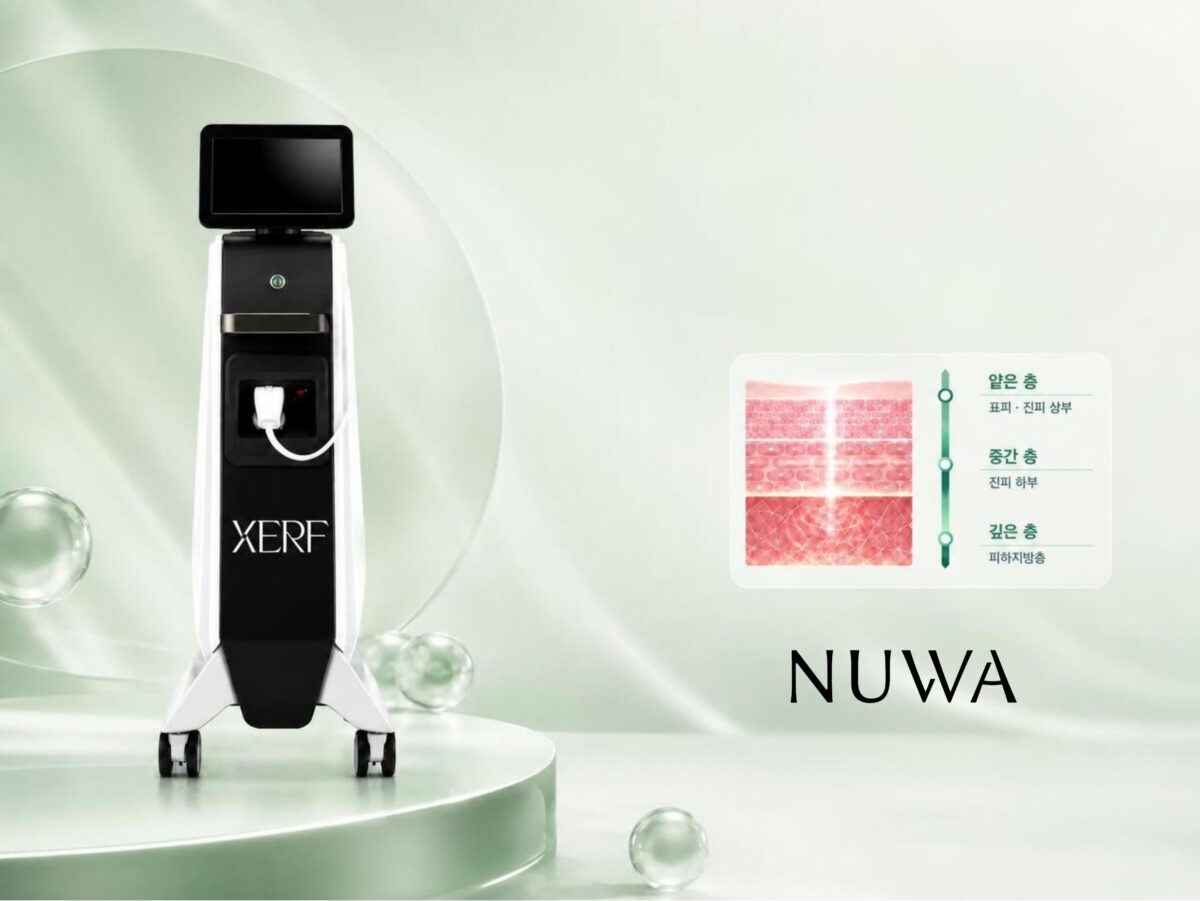
Xerf, by contrast, uses monopolar dual radiofrequency. Rather than gathering energy at one point, it delivers heat broadly and evenly from the full thickness of the dermis to the upper subcutaneous fat layer, prompting remodelling of slackened collagen and rebuilding dermal density. If Ultherapy’s role is to draw up the deep pillars, Xerf’s is to fill in the foundation across the full thickness of the skin, so they are not treatments that can substitute for one another.
What are Xerf’s dual frequencies?
Xerf outputs two frequencies together, 6.78MHz and 2MHz.
6.78MHz acts on the shallower upper and middle dermis, refining fine lines and tightening pores and the surface. 2MHz carries heat past that resistance into the deeper lower dermis and the upper subcutaneous fat layer, creating the groundwork for holding slackened cheeks and the lower jaw line. Combining the two allows shallow, middle and deep layers to be regulated in stages. In other words, the two frequencies differ not in intensity but in the depth they reach, so deciding that distribution is itself the treatment planning.
How do they compare at a glance?
| Aspect | Ultherapy | Xerf |
|---|---|---|
| Energy | High-intensity focused ultrasound (HIFU) | Monopolar dual radiofrequency (RF) |
| Delivery method | Focused at one point to form thermal coagulation points | Heat delivered broadly and evenly |
| Main target layer | Fascial (SMAS) layer | Full-thickness dermis to upper subcutaneous fat layer |
| Where the emphasis falls | Drawing a descended contour upwards | Dermal density and surface refinement |
The basis for choosing between the two is not which is stronger or better but which layer your sagging began in.
How is the treatment planned?
The layer the sagging sits in and the thickness of the facial fat are the starting points for the judgement.
- When we look at Ultherapy first — where there is a reasonable amount of facial fat and the fascial layer of the deep cheeks or jawline has descended, so the facial contour needs drawing upwards
- When we look at Xerf first — where the skin is thin or facial fat is limited and hollowing is a concern, or where loss of density needs addressing alongside fine lines and pores
Where both conditions are present, we sometimes plan them separately: the deep layer with Ultherapy, and full-thickness dermal density with Xerf. Whether to combine them and at what intervals is decided after checking the condition of the tissue.
How does the discomfort differ?
Because the energy is delivered differently, the sensation differs too.
Ultherapy gathers and forms thermal coagulation points in a specific layer, so a deep, heavy sensation comes with it. Xerf, by contrast, divides the heat across a broad area and cools the epidermis with ICD contact cooling to reduce the burden of heat. The difference in sensation comes not from one treatment being better than the other but from how the energy is gathered and delivered. How much pain is felt varies considerably from person to person, and both treatments can be adjusted as they go.
What should be observed after Xerf?
Xerf is a non-invasive method that leaves no damage to the surface, so the return to daily life is quick.
- Redness, swelling and slight discomfort may appear straight afterwards, usually settling within a few hours.
- While redness remains, use lukewarm water rather than hot water for washing and showering.
- For about a week, avoid peels and care that exposes the skin to high heat.
- Apply sun protection of SPF 30 or higher when going out.
The principle of aftercare is to add no further heat or stimulation while collagen production is under way in the dermal layer.
With lifting, no single device is the answer to every kind of sagging. The order is to check fat volume, skin thickness, dermal density, and whether the sagging came from the fascia or from a loss of resilience, and then decide on the device. You can also see the options set out together in our lifting guide, and we will go through it with you at the consultation.
Frequently asked questions
Q. Which is better, Xerf or Ultherapy?
A. It is not a question of better or worse; they work on different layers. Sagging descended from the fascial layer leans towards Ultherapy; dermal density, fine lines and pores lean towards Xerf. It is decided by which layer your sagging came from.
Q. I don’t have much facial fat. Which suits me?
A. Where the skin is thin or fat volume is limited and hollowing is a concern, Xerf, which works broadly across the full thickness of the dermis, is often looked at first. If deep-layer sagging is also present, we consider combining them with an adjusted scope.
Q. Can I have both treatments together?
A. They work on different layers, so we sometimes plan them together — the deep layer with Ultherapy and full-thickness dermal density with Xerf. Whether to combine them and at what intervals is decided after checking the condition of the tissue.
Q. What is different about Xerf’s frequencies?
A. 6.78MHz refines fine lines, pores and the surface in the shallower upper and middle dermis, while 2MHz carries heat into the deeper lower dermis and the upper subcutaneous fat layer. It is a difference in the depth reached, not in intensity.
Q. Is Xerf very painful?
A. Xerf divides the heat across a broad area and cools the epidermis with ICD contact cooling adjustable across three levels, so the burden of heat tends to be limited. How much is felt varies from person to person, and adjustments can be made as we go.
Q. Can I go about my day straight after Xerf?
A. The method leaves no damage to the surface, so washing your face, wearing make-up and going out present no great difficulty. If redness remains, though, please avoid hot water, and hold off on high-heat care and peels for about a week.
*Effects and results of this treatment may vary with individual condition, and responses such as redness, swelling or warmth may appear afterwards. Accurate diagnosis and the decision on whether to proceed should be made through consultation with the medical team.

NUWA Clinic Gangnam
Dermatology · Lead Director, NUWA Clinic Gangnam
With know-how built over 10 years and more than 120,000 procedures, I'll help you find the answer to your facial concerns.