
Xerf: Why the Treatment Differs by Area
Four tips, three-level ICD contact cooling and an automatic cut-out above 43 degrees. NUWA Clinic Gangnam on how Xerf divides area and discomfort.
Contents
“My skin seems to be sliding downwards and it has no strength to it.” “My contours have become blunt — which treatment should I have?” These are things we hear often at consultations. Plenty of people look into lifting because of concerns like these, but many hesitate, because radiofrequency treatments have a reputation for intense heat. Xerf is a lifting treatment that addresses that aspect. Today we will explain how Xerf, available at our clinic near Gangnam Station, actually works.
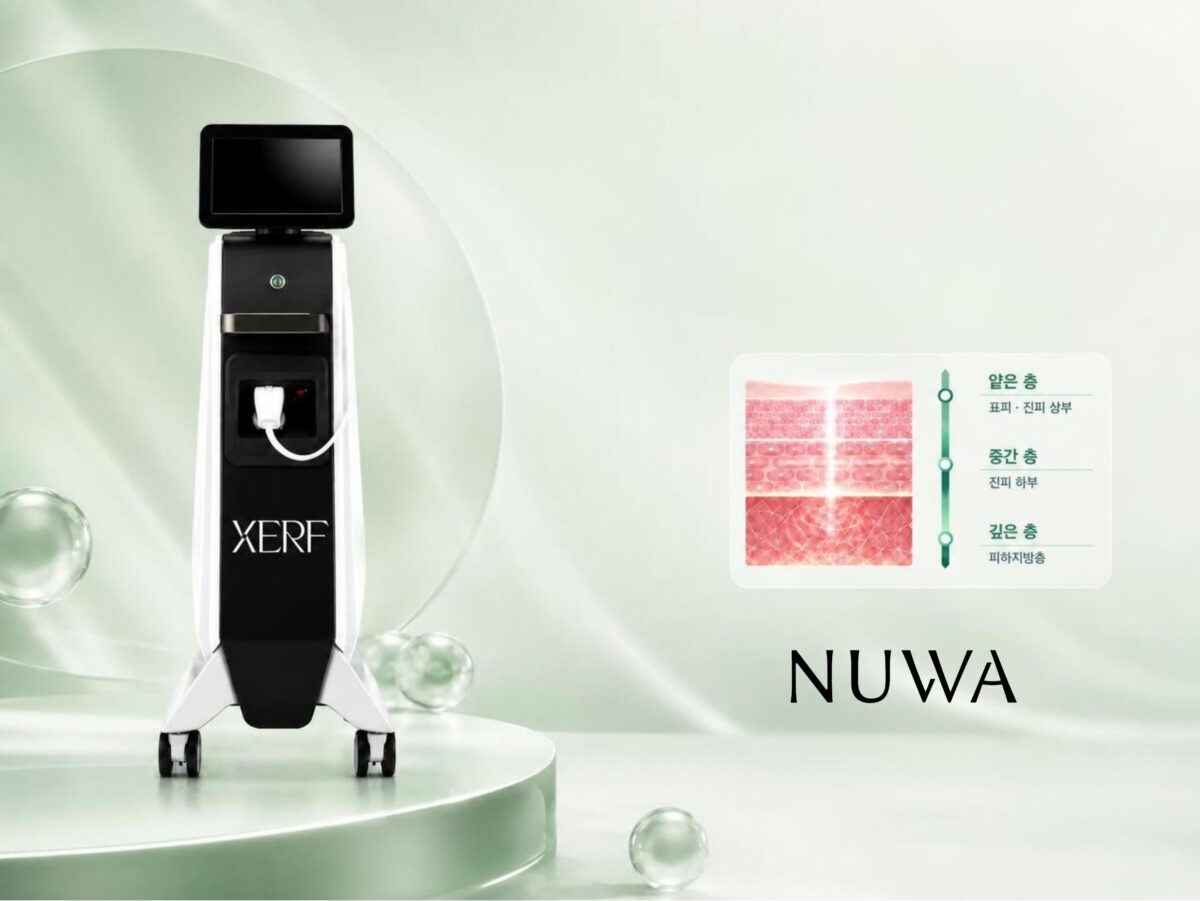
Xerf has a structure that divides and regulates discomfort. There are four tips in total, for the broad cheeks and under the chin, for the eye area and for the mouth area. Alongside them, ICD contact cooling can be adjusted across three levels, and a mechanism that cuts out automatically when the surface temperature exceeds 43 degrees works in parallel.
Why does Xerf use two frequencies together?
The skin differs in structure and thickness by position, from the epidermis to the upper dermis, the lower dermis and the deep subcutaneous layer.
Using a single frequency tends to concentrate energy at one particular depth. Xerf delivers 6.78MHz and 2MHz alternately, so that everything from the shallow dermis to the deep subcutaneous layer can be regulated in stages.
6.78MHz acts on the upper and middle dermis, prompting collagen fibres to contract and taking on the tidying of surface density, while 2MHz carries energy into the lower dermis and subcutaneous layer, working to draw up a descended lower face and jawline. The two frequencies are used together less to increase output than to address different depths of the skin at once.
Why are different tips used by area?
The face is not a flat plane. The broad cheeks and the narrow, contoured eye area differ in skin thickness and in bone structure alike.
| Tip | Areas mainly used on | Concerns addressed |
|---|---|---|
| Large and medium | Broad areas such as the cheeks and under the chin | Jawline definition, deep-layer resilience |
| Small and fine | Eye area, forehead, around the nose wings, mouth area | Fine lines, precise surface refinement |
Treating the whole face with a single tip makes close contact difficult in narrow areas, so energy may not be delivered evenly. In other words, dividing the tips is not about delivering stronger energy but about reducing gaps in narrow, contoured places.
How does the cooling work?
ICD contact cooling is a method in which the tip surface cools the epidermis in real time at the moment energy is delivered.
The outer surface of the skin stays cool while heat still reaches the deeper layers, so the treatment can proceed with less perceived heat. The cooling can be adjusted across three levels according to individual sensitivity and the intensity of the treatment. Dividing the cooling into levels means the same treatment can be carried out differently to match each person’s pain threshold.
What happens if the skin temperature rises?
The handpiece contains a device that monitors skin surface temperature in real time. If the temperature exceeds 43 degrees, the output cuts out automatically. Because cooling and temperature sensing work together, the device checks once more rather than relying on the practitioner’s judgement alone. The temperature cut-out is not a function that limits energy but a baseline that keeps the skin surface from going past what it can take.
Who does it suit?
- Those whose cheeks have slackened and whose lower facial contour looks blunt
- Those who have hesitated because of heat and discomfort in previous radiofrequency treatments
- Those bothered by fine lines and pores who also need surface refinement
- Those who need to return to daily life the same day, without bruising, swelling or damage to the epidermis
- Those who want an approach divided from shallow layers to deep ones
Xerf suits not so much those who want an intense treatment as those who want area and discomfort conditions divided up and regulated.
What should be observed afterwards?
Xerf is a non-invasive method that leaves no damage to the epidermis, so the return to daily life is quick. Collagen renewal is under way in the dermal layer, though, so it is worth taking care for a few days.
- Redness, mild swelling and slight discomfort may appear straight afterwards, usually settling within a few hours.
- While redness remains, use lukewarm water rather than hot water for washing and showering.
- For about a week, avoid peels and care that applies high heat.
- Apply sun protection of SPF 30 or higher when going out.
If symptoms worsen or persist, please be sure to contact the clinic. The principle of aftercare is to add no external heat or stimulation while renewal in the dermal layer is under way.
With lifting, using high output does not lead to a better result. Skin thickness, dermal density and the way the facial muscles are used all differ, so checking the structure and then matching penetration depth and energy level comes first. If declining resilience and a blurred contour have been on your mind, we will go through it together at the consultation. You can also compare the lifting options in our lifting guide.
Frequently asked questions
Q. Can narrow areas such as around the eyes be treated?
A. Small and fine tips are used on narrow, contoured areas such as the eye area, forehead, around the nose wings and the mouth area. Whether they can be applied to a given area is decided after checking skin thickness and condition, so please raise it at the consultation.
Q. Is the treatment very painful?
A. ICD contact cooling cools the epidermis at the moment energy is delivered, and can be adjusted across three levels according to sensitivity, so the burden of heat tends to be limited. How much is felt varies from person to person, and adjustments can be made as we go.
Q. Is there a risk of burns?
A. A mechanism that cuts the output automatically when the surface temperature exceeds 43 degrees works in parallel. Responses can still differ with skin condition in any treatment, though, so please tell us straight away if you are uncomfortable during the session.
Q. Can only one of the two frequencies be used?
A. The weighting changes according to which layer the sagging began in. Where surface resilience remains but only the contour has descended, the weighting shifts towards 2MHz, which handles the deeper layer.
Q. Can I wash my face and wear make-up straight afterwards?
A. The method leaves no damage to the epidermis, so both are possible straight afterwards. If redness remains, please use lukewarm rather than hot water, and avoid peels for about a week.
Q. When do the changes start to show?
A. A change from collagen contraction may be felt straight afterwards, while renewal continues over the following months. The timing and degree vary from person to person with age and skin condition.
*Effects and results of this treatment may vary with individual condition, and responses such as redness, swelling or warmth may appear afterwards. Accurate diagnosis and the decision on whether to proceed should be made through consultation with the medical team.

NUWA Clinic Gangnam
Dermatology · Lead Director, NUWA Clinic Gangnam
With know-how built over 10 years and more than 120,000 procedures, I'll help you find the answer to your facial concerns.